
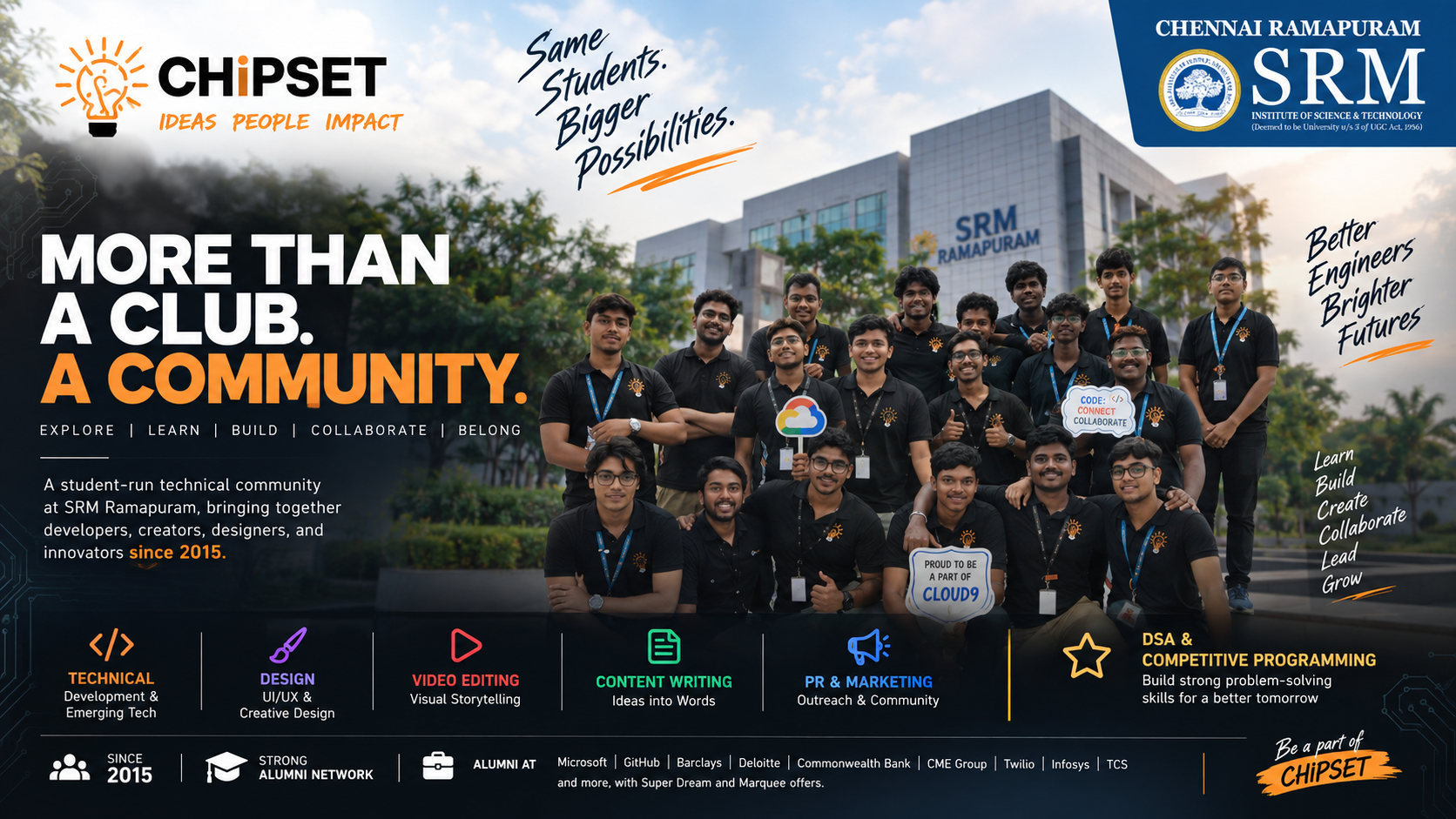
Technical Clubs in SRM & SRM Ramapuram: Why You Should Join CHiPSET
College life is about more than maintaining a high GPA and sitting through lectures. For students pursuing engineering and computer science, some of the most valuable experiences happen outside the curriculum — building projects, participating in hackathons, writing code, exploring new technologies, and collaborating on real-world ideas.
At SRM Institute of Science and Technology (SRMIST), student communities provide opportunities for students to explore their interests beyond the classroom. For students at the SRM Ramapuram campus, technical clubs can provide an environment where classroom concepts meet practical application.
Whether you're interested in software development, artificial intelligence, cloud computing, design, content creation, or marketing, joining a student community can help you explore your interests while developing skills that extend beyond academics.
One of the long-standing technical communities at SRM Ramapuram is CHiPSET — a student-run technology community that has been bringing together students interested in technology, innovation, development, and collaboration since 2015.
What Is a Technical Club?
A technical club is a student-led community focused on technology, engineering, innovation, programming, and practical problem-solving.
Unlike traditional classroom learning, technical clubs provide opportunities to learn through:
A technical club isn't a replacement for academics.
Instead, it can complement your academic learning by giving you opportunities to apply what you learn.
Why Should You Join a Technical Club at SRM?
1. Learn Beyond the Syllabus
Your university curriculum gives you important fundamentals.
However, technology changes rapidly.
Frameworks, programming tools, cloud platforms, AI technologies, development practices, and software ecosystems continue to evolve.
A technical community gives students an environment to explore technologies beyond what they encounter in regular coursework.
You can take something you learned in class and experiment with how it works in a practical project.
2. Build Real Projects
There is a major difference between knowing how something works and actually building something with it.
Technical clubs can give students opportunities to work on projects involving:
Building projects teaches you things that textbooks cannot always simulate:
Debugging. Deployment. Collaboration. Documentation. Version control. Failure. Iteration.
These experiences can eventually become part of your technical portfolio.
3. Explore Different Areas of Technology
You don't necessarily know your area of interest when you enter college.
You might start with web development and discover AI.
You might begin with programming and later become interested in cloud computing.
You might explore cybersecurity, backend development, or another emerging technology.
Technical clubs give students the freedom to experiment.
You don't need to decide your entire technical career in your first year.
Try things. Build things. Discover what you enjoy.
4. Develop Teamwork Skills
Real-world technology is rarely built entirely by one person.
Technical projects often involve developers, designers, researchers, content creators, marketers, and project coordinators working together.
Being part of a technical community can teach you how to:
These experiences can complement your technical knowledge with practical teamwork skills.
5. Learn From Seniors and Peers
One of the biggest advantages of joining a student technical community is peer learning.
Seniors may already have experience with:
Their experiences can help juniors understand how to approach opportunities and avoid common mistakes.
At the same time, students from different years can collaborate and learn from each other.
A technical community can therefore become a continuous learning network across batches.
6. Participate in Hackathons and Technical Events
Hackathons and technical competitions provide a completely different learning environment.
Instead of spending weeks learning a concept in isolation, a hackathon may require you to:
Understand a problem → Develop an idea → Build a prototype → Debug → Present
all within a limited period.
These experiences can improve problem-solving, teamwork, time management, communication, and technical implementation.
Technical clubs can also expose students to workshops, seminars, coding competitions, project showcases, and other technology-focused events.
7. Develop Leadership and Communication Skills
A technical club isn't only about coding.
As students become more involved, they may take responsibility for:
These responsibilities can help students develop communication, leadership, public speaking, event-management, and decision-making skills.
8. Build Your Technical Portfolio
Your academic record shows what you studied.
Your portfolio can show what you actually built.
Projects, GitHub repositories, hackathons, technical articles, workshops, competitions, and other practical experiences can help students demonstrate their interests and capabilities.
Instead of simply writing:
Python
you can eventually demonstrate:
Built a Python-based project and deployed it as part of a team.
That transition from learning to building is one of the most valuable outcomes of technical communities.
Do You Need to Be an Expert to Join?
No.
One of the biggest misconceptions among first-year students is that technical clubs are only for experienced programmers.
You don't need advanced coding skills to get started.
If you're a beginner, you can start by:
Your first project doesn't need to be impressive.
Your first hackathon might be difficult.
Your first presentation might not go perfectly.
That's part of the learning process.
The purpose of joining a technical community is not to prove that you already know everything.
It is to give yourself an environment in which you can become better.
Technical Clubs at SRM and SRM Ramapuram
Students searching for technical clubs in SRM may be looking for communities where they can explore technology, build projects, participate in events, and connect with other students.
For students specifically looking for technical clubs in SRM Ramapuram, the Ramapuram campus has a student technical ecosystem covering different interests and activities.
Different communities can offer different areas of focus.
Some students may be interested primarily in programming and development.
Others may prefer design, content, media, outreach, or event management.
This diversity gives students opportunities to find communities that match their interests.
Among the long-standing technical communities at SRM Ramapuram is CHiPSET.
CHiPSET — A Long-Standing Technical Community at SRM Ramapuram
CHiPSET is a student-run technical community at SRM Ramapuram, established in 2015.
Over the years, the community has brought together students interested in programming, technology, innovation, development, design, communication, and other areas.
CHiPSET's goal is to create an environment where students can:
Learn → Build → Collaborate → Lead → Grow
Being part of a long-standing student community also means becoming part of a network that extends across multiple batches.
A Community With Multiple Domains
Technology is not limited to programming.
A successful technology community needs people who can build products, design experiences, create content, communicate ideas, manage outreach, and bring projects to audiences.
That's why CHiPSET has a variety of domains catering to different interests and skill sets.
Students can explore areas including:
Technical
Programming, software development, emerging technologies, and technical projects.
Design
Visual design, UI/UX, creative design, and design for technical initiatives.
Video Editing
Creating and editing visual content for events, projects, campaigns, and community activities.
Content Writing
Technical writing, creative writing, documentation, articles, and communication.
PR & Marketing
Promotion, outreach, social media, audience engagement, partnerships, and community visibility.
This means you don't have to be an advanced programmer to find a place in CHiPSET.
If you enjoy designing, there is Design.
If you enjoy writing and storytelling, there is Content Writing.
If you enjoy creating visual content, there is Video Editing.
If you enjoy communication and outreach, there is PR & Marketing.
And if you enjoy programming and building software, there is the Technical side of the community.
Your First Domain Doesn't Have to Be Your Final Domain
One of the advantages of having multiple domains is that students aren't restricted to one area forever.
You can initially choose a domain that interests you and become comfortable there.
But you can also explore other domains as you progress.
A student might start with Design and later become interested in Technical development.
Someone interested in Content Writing might discover an interest in PR and Marketing.
A technical member might explore Design or Video Editing to understand how products and projects can be communicated more effectively.
Your interests can change.
Your skills can change.
Your goals can change.
And your domain can change too.
Choose → Learn → Contribute → Explore → Switch → Grow.
The idea is to give students room to discover what they genuinely enjoy while developing depth in the areas where they feel most comfortable.
DSA and Competitive Programming Culture at CHiPSET
While Competitive Programming is not a separate domain within CHiPSET, the community places importance on developing strong programming and problem-solving fundamentals.
One of the major areas students can train in is Data Structures and Algorithms (DSA).
For students pursuing software development and computer science, DSA is an important foundation for understanding how to organize data, design algorithms, analyze efficiency, and solve programming problems.
CHiPSET encourages students to develop these skills through DSA learning, problem-solving practice, and competitive programming training.
Why Is DSA Important?
Technical assessments and coding interviews often require candidates to solve programming problems and explain their approach.
DSA helps students develop the ability to:
These skills can be useful for:
Students can progressively work through topics such as:
The objective isn't simply to solve as many questions as possible.
It is to understand how to think about problems and develop efficient solutions.
From Fundamentals to Problem Solving
Programming Fundamentals ↓ Data Structures ↓ Algorithms ↓ Complexity Analysis ↓ Problem Solving ↓ Competitive Programming
This training complements the broader technical activities at CHiPSET, allowing students to work on projects while also strengthening the fundamental problem-solving skills required in software development and technical assessments.
CHiPSET Workshops, Hackathons and Technical Events
CHiPSET's activities extend beyond regular learning sessions.
The community has organized technical events covering different areas of technology and development.
Its event history includes initiatives such as:
CLOUD9 ft Google
Recently, CHiPSET hosted CLOUD9 ft Google at SRM Ramapuram, bringing students hands-on exposure to Google Cloud technologies.
As part of the collaboration with Google, all event participants received free Google Cloud credits, giving them the opportunity to continue experimenting, building, and learning on the platform even after the event.
Learn → Get Credits → Build → Explore.
These activities provide opportunities for students to explore technologies, collaborate with peers, compete, build projects, and participate in the broader technology community at SRM Ramapuram.
Learning by Doing
The philosophy behind a technical community can be summarized as:
Don't just learn technology. Use it.
A workshop can introduce you to a technology.
A project can help you understand it.
A hackathon can challenge you to apply it.
Working with a team can teach you how to build collaboratively.
Taking responsibility can help you develop leadership.
And mentoring someone else can reinforce what you have learned.
This creates a continuous cycle of learning.
CHiPSET Alumni and Career Journeys
A long-standing student community is also defined by the people who have passed through it.
Since its establishment in 2015, multiple generations of students have been part of CHiPSET and have gone on to pursue careers across technology, consulting, finance, software, and other industries.
CHiPSET alumni have gone on to work at organizations including:
The CHiPSET alumni network also includes students who have secured Super Dream and marquee placement opportunities.
These alumni journeys provide current students with examples of the different paths that can follow a strong technical and professional learning experience during college.
Importantly, joining a club does not guarantee a placement or a particular career outcome.
Instead, the value lies in the environment it can provide for students to develop skills, build projects, collaborate, learn from seniors, and prepare themselves for future opportunities.
How to Get the Most Out of a Technical Club
Joining a technical club is only the beginning.
To make the most of your experience:
Start Early
Joining in your first or second year gives you more time to explore different areas, contribute to projects, and eventually take on responsibilities.
Don't Just Attend — Participate
Attending workshops is useful.
But applying what you learn is even more valuable.
Build projects.
Join teams.
Contribute.
Experiment.
Explore Multiple Domains
Don't be afraid to try something outside your initial interest.
Your first domain may not be your final one.
Practice DSA Consistently
If you're interested in software development or placements, don't wait until your final year to start learning DSA.
Build the habit gradually.
Participate in Hackathons
Hackathons can teach you how to build and collaborate under constraints.
Take Responsibility
Organize an event.
Lead a project.
Create content.
Help a junior.
Take ownership.
Leadership is developed through responsibility.
Why CHiPSET?
If you're searching for technical clubs in SRM, technical clubs in SRM Ramapuram, tech clubs in SRM, or coding communities at SRM, the right community depends on your interests and what you want to learn.
CHiPSET offers a combination of:
Multiple Domains
Technical, Design, Video Editing, Content Writing, and PR & Marketing.
Technical Learning
Technology workshops, projects, development, and emerging technologies.
DSA & Problem Solving
Training and practice in Data Structures and Algorithms and Competitive Programming.
Events
Hackathons, coding activities, workshops, seminars, and technical events.
Peer Learning
Opportunities to learn from seniors and collaborate with students across batches.
Long-Term Community
A student community established in 2015 with multiple generations of members and alumni.
Alumni Network
Graduates who have gone on to organizations including Microsoft, GitHub, Barclays, Deloitte, Commonwealth Bank, CME Group, Twilio, Infosys, and TCS.
Start Building Beyond the Syllabus
Your academic syllabus gives you the foundation.
Your experiences outside the classroom can teach you how to apply it.
You don't need to be an expert before joining a technical club.
You don't need to know your final domain.
You don't need to know exactly what career you want.
Start with something that interests you.
Learn.
Build.
Collaborate.
Explore something new.
And if your interests change, try another domain.
For students searching for technical clubs in SRM or technical clubs in SRM Ramapuram, CHiPSET provides a student community where different interests can come together — from technical development and DSA to design, video editing, content writing, PR, and marketing.
Established in 2015, CHiPSET continues to bring students together around technology, creativity, collaboration, and learning at SRM Ramapuram.
Learn beyond the classroom. Build beyond the syllabus. Explore beyond your domain.
Build with CHiPSET.
Written by Chakradhar on September 15, 2026